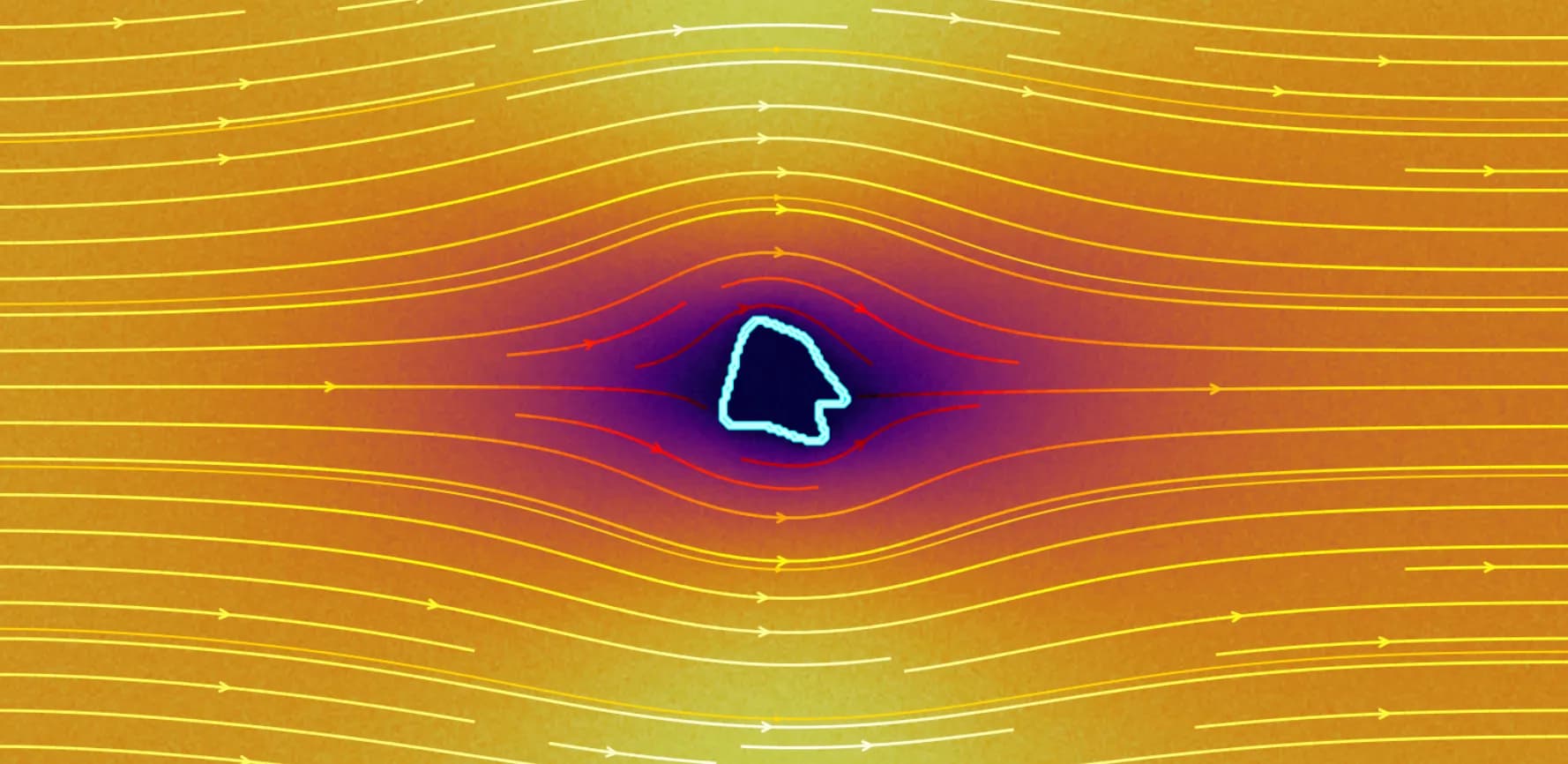
Engineers and researchers spend considerable time running mathematical simulations to approximate complex physics on controlled, real-world systems. Despite centuries of progress, many areas of physics remain poorly understood. While modeling unknown physics is beyond the scope of this article, ongoing research is pushing the boundaries of enabling AI to implicitly learn physics from observational data alone. This line of research is still nascent, but it holds immense potential for future breakthroughs.
Even with a solid understanding of physical laws, accurately predicting physical responses in engineered systems is anything but straightforward. Understanding design performance under specific physical constraints is a complex feat that can take anywhere from days to years, often requiring teams of expert engineers to computationally simulate design configurations and external loading conditions.
The time and cost required to run these simulations make it a fundamental bottleneck in engineering workflows. Long runtimes make iteration slow, while the high cost limits the number of iterations that can practically be run. The relative inaccuracy of these simulations compared to the real-world observation requires teams to build physical prototypes to test for validation. This is one reason---other reasons include inadequate communication among teams, governmental regulation, etc.---why it takes ~20 years to design a new aircraft, and why technologies like flying cars and micro-nuclear reactors remain unrealized to this day.
Faster simulations, therefore, would make it quicker for teams to test and build complex systems, leaving a lot of time to focus on manufacturing, compliance and selling among other business operations.
AI has shown great promise in simulating the physical world. With neural approximations ranging from Physics-Informed Neural Networks (PINNs) to Neural Operators (NOs), researchers have demonstrated their ability to approximate physics with less than 1–2% error compared to numerical solvers. However, the problem remains unsolved. PINNs still struggle to converge even in simple 2D domains and have not been effectively extended to 3D. Neural Operators, on the other hand, are promising and have seen some real-world deployment, but they are yet to be applied successfully to more complex use cases.
The potential impact of these solutions is exponential, driving an active and growing focus on improving them. Following the technological feasibility thesis [1], it is reasonable to assume that AI will play a significant role in how we build products—possibly leading to products superior to those we build today. However, the thesis only addresses the feasibility of the technology. The more curious question is: is it technically feasible to build AI that can match—or even surpass—current physics approximation methods? Could we develop a general model that replaces the entire suite of numerical solvers within a specific domain (e.g., structural, fluidic, or thermo-mechanical analysis)? Or even more ambitiously, a model that can approximate any physics on any input geometry?
Two Roadblocks
Given sufficient resources, there is no fundamental physical limitation preventing the development of such a general system—making it theoretically feasible to build in the future.
At present, however, solutions tend to favor specificity. From first principles, an effective solution today must satisfy three key criteria. First, it must be sufficiently generalizable to handle the varying geometries and designs that engineers encounter. Second, it must accurately model physics to be a reliable tool for addressing complex engineering challenges. Third, it must be capable of uncertainty quantification to recognize its own limitations and enable effective fallback strategies.
That said, the path to AI-based solvers is inherently incremental—starting with simpler physics and gradually advancing toward more complex phenomena. Similarly, generalizability is incremental, with current models being tailored to specific design domains, physical phenomena, and boundary conditions. While the ultimate limit of generalizability remains uncertain, it is clear that each iteration brings us closer.
Here are the two roadblocks towards building these physically-accurate AI models.
1. Data
AI solvers are primarily valuable for simulating complex geometries—since simpler ones are already efficiently handled by numerical solvers—so it’s crucial that today’s AI solutions meet those higher standards. Training models on these complexities requires simulation data from such geometries, which is inherently difficult to obtain due to the high cost and long runtimes of existing methods.
Although the business case for generating large datasets is strong, data requirements grow exponentially with both the number of input features and the complexity of the modeled physics—for example, varying geometries alone versus varying geometries along with changing boundary conditions and constraints.
Yet even unlimited simulation data might still fall short.
2. Algorithm
Despite having abundant text data and sufficiently powerful GPUs for much of the digital age, language models only became feasible once the transformer architecture was formalized and adapted for scalable training.
Similarly, AI architectures for physics are still in their infancy and remain an active area of exploration. Although current methods show promise, they face well-known limitations—for example, PINNs struggle with convergence and are particularly challenged by complex, non-linear physics. Neural Operators, meanwhile, currently rely on structured input representations. Yet most real-world scenarios involve unstructured data—an area still under active investigation.
No existing method can yet reliably capture multiple physical domains or generalize to zero-shot physical inference.
What’s Next?
Personally, I believe building these systems is essential—our future may well depend on it. AI capable of modeling physics could enable faster engineering breakthroughs, more sustainable products, and environmentally efficient alternatives to today’s modeling practices.
I believe current models can already be effectively applied to many real-world scenarios, and that data and algorithmic limitations are challenges for the longer term.
In the short term, it’s important to focus on building models that generalize well within narrowly defined domains, where data is especially costly. With better algorithms—whether through improved data efficiency (e.g., via implicit biases or transfer learning) or enhanced generalizability—we can hope to teach AI one more physics lesson with each iteration.
Footnotes:
[1] This perspective aligns with the notion that if a technology is feasible and offers substantial utility, its development is not just possible but probable—a concept echoed by thinkers like Bostrom, Deutsch, and Ellul.